
 Log In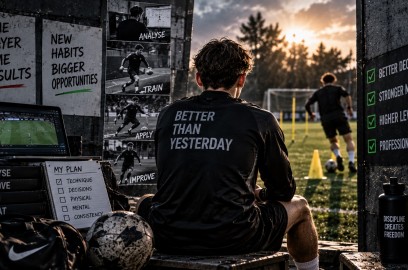
Many players train extra.
But there is a big difference between:
TRAINING MORE
and
TRAINING WHAT YOUR POSITION ACTUALLY NEEDS.
If you want to become professional, don't just become a “better footballer.”
Become better at the things clubs need FROM YOUR POSITION.
Here is a simple system you can start this week.
-
WRITE DOWN THE 5 MOST IMPORTANT ACTIONS FOR YOUR POSITION
Forget complicated training plans.
Start with your job on the pitch.
For example:
WINGER:
1v1
acceleration
crossing/final pass
movement behind defence
goals and assists
CENTRE-BACK:
1v1 defending
aerial duels
positioning
passing under pressure
progressing the ball
CENTRAL MIDFIELDER:
scanning
receiving under pressure
forward passing
positioning
winning second balls
STRIKER:
movement in the box
finishing
runs behind defence
protecting the ball
pressing
Now you know what you are actually trying to improve.
-
WATCH YOURSELF FOR 90 MINUTES
Highlights aren't enough.
Watch one complete match.
Take a piece of paper.
For each of your five areas write:
GOOD
AVERAGE
WEAK
Be honest.
You are looking for the part of your game that could stop you reaching a higher level.
-
CHOOSE ONE PROBLEM
Don't try to improve ten things simultaneously.
Choose the weakness that hurts your performance most.
You are a winger who can dribble but your final pass is poor?
That's your target.
You are a midfielder who is technically good but loses possession because you don't scan?
That's your target.
One clear problem gives your training direction.
-
BUILD TWO EXTRA SESSIONS AROUND IT
You don't necessarily need two extra hours every day.
Even 20–30 focused minutes can be useful.
If your problem is your weak foot:
receive → pass → receive → play forward.
If it is finishing:
movement → receive → finish quickly.
If it is scanning:
check surroundings → receive → decide → pass.
Make your training look like situations that actually happen in matches.
-
ADD PRESSURE
This is where many individual sessions fail.
You become excellent at an exercise when nobody is defending you.
Then the match starts and everything changes.
Make training progressively harder:
LESS TIME.
LESS SPACE.
FEWER TOUCHES.
MORE SPEED.
ADD AN OPPONENT.
ADD DECISIONS.
Your technique must work under pressure.
-
GIVE YOURSELF ONE MATCH MISSION
Before your next match choose ONE objective.
For example:
“I will scan before receiving whenever possible.”
“I will attack the space behind the full-back more often.”
“I will try to play forward immediately when space appears.”
Now your match becomes part of your development.
-
REVIEW IT AFTER THE MATCH
After the game ask:
DID I DO IT?
HOW MANY TIMES?
WHAT WORKED?
WHAT FAILED?
WHAT SHOULD I TRAIN NEXT?
If possible, watch the match on video.
Then repeat:
WATCH.
IDENTIFY.
TRAIN.
APPLY.
REVIEW.
IMPROVE.
FINAL MESSAGE
Maybe you don't have a personal coach.
Maybe you don't have an academy.
Maybe your club only trains three times per week.
That makes development harder.
But it doesn't mean your individual development has to become random.
Take responsibility for your progress.
KNOW WHAT YOUR POSITION REQUIRES.
FIND YOUR BIGGEST PROBLEM.
TRAIN IT.
TEST IT IN MATCHES.
ANALYSE THE RESULT.
THEN START AGAIN.
Don't spend the next year simply hoping that regular team training will somehow turn you into a professional player.
BUILD THE PLAYER YOUR POSITION REQUIRES.
ONE WEAKNESS AT A TIME.
SUPPORT FOR PLAYERS
For 6 years, we have been helping less-known players completely for free — guiding them, giving honest feedback, and creating real football opportunities. During this time, we have completed over 25 player transfers to clubs across Europe.
If you value our work and want to help us continue supporting players worldwide, you can support us through Football Talents Tube.
Every supporter will have the chance to speak personally with me.
I will check your level, give you real feedback, and guide you individually.
The most determined players receive invitations for official trials.