
 Log In
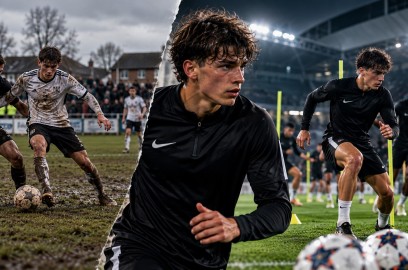
You are one of the best players in your local league.
You have good technique.
You score goals, create chances or win defensive duels.
You believe you deserve to play professionally.
But here is an important question:
IF YOU JOINED A PROFESSIONAL TEAM TOMORROW, WOULD YOU BE ABLE TO KEEP UP?
Many talented amateur players underestimate the difference between lower-league and professional football.
They believe they only need an agent, a trial or someone who believes in them.
But professional clubs need players who can perform at the required level.
And the difference is often not one spectacular skill.
It is the speed, quality and consistency of hundreds of small actions.
Here are 7 abilities you should develop if you want to close that gap.
-
MAKE DECISIONS BEFORE THE BALL REACHES YOU
In lower leagues, you may have enough time to receive the ball, look around and decide what to do.
Against stronger opponents, that time can disappear.
Professional players often prepare their decisions before receiving a pass.
WHAT TO DO:
During training, develop three habits:
-
Look around before receiving the ball.
-
Identify at least two possible options.
-
Decide where your first touch should take you.
PRACTICAL EXERCISE:
Play a 4v2 possession game in a small area.
Start with three touches, then try two.
Increase defensive pressure as you improve.
Don't sacrifice accuracy just to play faster.
Your goal is to make good decisions in less time.
-
IMPROVE YOUR FIRST TOUCH UNDER PRESSURE
You may have excellent ball control when nobody is close to you.
But what happens when a defender is pressing from behind?
A poor first touch can destroy an attack before it begins.
At a higher level, controlling the ball is not enough.
Your first touch should prepare your next action.
WHAT TO DO:
Practise receiving passes from different angles.
Use both feet.
Receive while moving.
Add a defender who applies realistic pressure.
PRACTICAL EXERCISE:
Work with two teammates.
One passes the ball.
The second applies pressure.
Your task is to receive, protect possession and find a passing option.
Start with moderate pressure and increase the difficulty.
Measure how often you keep possession successfully.
-
LEARN TO PLAY WHEN YOU HAVE VERY LITTLE SPACE
Many talented amateurs look excellent when they have space.
They can dribble.
They can pass.
They can turn.
But professional football often requires quality in crowded areas.
You must protect the ball, recognise pressure and find solutions.
WHAT TO DO:
Use small-sided games.
Play 3v3 or 4v4 in appropriately sized areas.
Practise protecting possession and escaping pressure.
Learn when to turn and when to pass backwards.
PRACTICAL EXERCISE:
Play 3v3 with two neutral players supporting the team in possession.
Your objective is to maintain possession while defenders press actively.
Gradually reduce the playing area if your group can maintain good technique.
Focus on movement, body position and quick decisions.
-
DEVELOP THE PHYSICAL QUALITIES YOUR POSITION REQUIRES
Being physically strong does not automatically make you ready for professional football.
Different positions have different demands.
A winger may need repeated acceleration and changes of direction.
A central midfielder may need to cover space, recover quickly and repeat high-intensity actions.
A centre-back may need explosive movements, strength and effective changes of direction.
WHAT TO DO:
Identify the physical qualities most important for your position.
Work on acceleration, strength, movement quality and football-specific conditioning.
PRACTICAL EXERCISE:
With your coach, include short accelerations of 5–20 metres, changes of direction and position-specific movements in your weekly programme.
Record your performance and review it over time.
Increase training demands gradually and allow enough recovery.
Remember:
YOU DON'T NEED TO LOOK LIKE A PROFESSIONAL FOOTBALLER.
YOU NEED TO DEVELOP THE PHYSICAL ABILITY TO PERFORM LIKE ONE.
-
IMPROVE YOUR POSITIONING BEFORE YOU IMPROVE YOUR RUNNING
Some amateur players believe they need to become much faster.
But sometimes their biggest problem is positioning.
They start moving too late.
They stand in the wrong place.
They fail to anticipate the next action.
A player with excellent positioning can sometimes reach the ball before a faster opponent.
WHAT TO DO:
Study professional players in your position.
Don't watch only their actions with the ball.
Watch what happens before those actions.
Where do they stand?
When do they move?
How do they react when possession changes?
PRACTICAL EXERCISE:
Choose 10 situations from a professional match.
Pause the video before the action develops.
Predict where the player should move.
Then watch what happens.
During your next match, focus on applying one positioning principle you learned.
-
BECOME CONSISTENT, NOT JUST SPECTACULAR
You play one incredible match.
You score twice.
You dominate your opponent.
But in the next three matches, you disappear.
This is a serious problem.
Professional clubs need players who can perform reliably over time.
One great performance does not prove you are ready for a higher level.
WHAT TO DO:
Evaluate your performances across several matches.
Don't focus only on goals or assists.
Choose indicators relevant to your position.
For example:
-
Striker: quality of movement, shots from good positions and involvement in attacks.
-
Midfielder: passing decisions, ball losses under pressure and defensive positioning.
-
Defender: successful duels, positioning mistakes and quality of possession.
-
Winger: dangerous actions, successful 1v1 situations and defensive contributions.
PRACTICAL EXERCISE:
Track your next five matches.
Identify which actions you perform well consistently and which remain unreliable.
Then build your training around the weaknesses that appear most often.
-
UNDERSTAND YOUR TACTICAL RESPONSIBILITIES
You may be technically excellent.
But if you constantly leave your position, ignore defensive responsibilities or fail to understand your team's structure, a professional coach may struggle to trust you.
At higher levels, individual quality must work within the team's system.
WHAT TO DO:
Learn your responsibilities in different situations:
-
When your team has possession.
-
When your team loses possession.
-
When your team presses.
-
When your team defends deep.
-
When your team wins the ball back.
PRACTICAL EXERCISE:
Ask your coach to explain three important responsibilities for your position.
During your next match, focus on executing them.
Afterwards, review whether you made the correct decisions.
You can also watch professional players performing similar tactical roles.
FINAL MESSAGE
Here is something every ambitious footballer should understand.
BEING ONE OF THE BEST PLAYERS IN YOUR AMATEUR LEAGUE DOES NOT AUTOMATICALLY MAKE YOU READY FOR PROFESSIONAL FOOTBALL.
You may have talent.
You may have excellent technique.
You may even be physically stronger than most opponents.
But the professional game can demand more.
Faster decisions.
Better first touches.
Higher quality under pressure.
Stronger physical preparation.
Intelligent positioning.
Consistent performances.
Tactical discipline.
And these are abilities you can work on.
YOUR CHALLENGE FOR THE NEXT 30 DAYS:
-
Choose the three skills from this article that need the most improvement.
-
Ask your coach for honest feedback.
-
Create specific exercises to develop those skills.
-
Test them during training and matches.
-
Record your progress and adjust your plan.
Don't expect to become a professional in 30 days.
Use those 30 days to begin closing the gap.
And remember something important:
YOUR GOAL SHOULD NOT BE TO LOOK LIKE A PROFESSIONAL PLAYER IN YOUR CURRENT LEAGUE.
YOUR GOAL SHOULD BE TO DEVELOP THE ABILITY TO COMPETE AGAINST PROFESSIONAL PLAYERS.
There is a big difference.
Stop asking only:
"HOW CAN I FIND A PROFESSIONAL CLUB?"
Start asking:
"WHAT MUST I IMPROVE SO THAT A PROFESSIONAL CLUB WOULD ACTUALLY WANT ME?"
Because the most important transfer you can make starts long before you sign a contract.
IT STARTS WHEN YOU TURN YOUR CURRENT ABILITY INTO THE LEVEL REQUIRED FOR YOUR NEXT OPPORTUNITY.
SUPPORT FOR PLAYERS
For 6 years, we have been helping less-known players completely for free — guiding them, giving honest feedback, and creating real football opportunities. During this time, we have completed over 25 player transfers to clubs across Europe.
If you value our work and want to help us continue supporting players worldwide, you can support us through Football Talents Tube.
Every supporter will have the chance to speak personally with me.
I will check your level, give you real feedback, and guide you individually.
The most determined players receive invitations for official trials.