
 Log In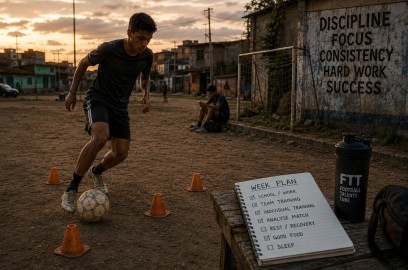
You want to become a professional footballer.
But you also have school, work, family responsibilities or long journeys every day.
You cannot train all day.
That does not mean you cannot develop.
The solution is not MORE training.
The solution is BETTER PLANNED training.
-
PLAN YOUR WEEK BEFORE IT STARTS
Every Sunday, write down:
School or work.
Family responsibilities.
Team training.
Match day.
Free time.
Then find 2–3 realistic periods for individual development.
Don't wait for free time.
Plan it.
-
GIVE EVERY SESSION ONE PURPOSE
Never go to the pitch just to "train."
Know exactly what you want to improve.
Monday: weak foot.
Wednesday: first touch.
Friday: finishing.
One clear goal makes limited time much more valuable.
-
USE SHORT SESSIONS WELL
You don't always need two hours.
Even 30–45 minutes can be useful.
Example:
5 min — warm-up
15 min — technical weakness
10 min — position-specific work
10 min — high-speed repetitions
5 min — test your result
Quality matters more than simply staying on the pitch longer.
-
TRAIN FOR YOUR POSITION
A striker and centre-back should not spend all their extra training doing the same exercises.
Ask yourself:
"What actions do I perform most often during matches?"
Then train them.
WINGER → 1v1, acceleration, crossing, finishing.
MIDFIELDER → scanning, receiving, turning, passing.
STRIKER → movement, first touch, finishing.
DEFENDER → positioning, passing, duels, defending space.
Train for the player you need to become.
-
TURN SIMPLE CONDITIONS INTO SERIOUS TRAINING
No academy?
No expensive equipment?
Use what you have.
A ball.
A wall.
A few bottles as markers.
A small field.
A phone.
But don't just repeat easy exercises.
Add challenges:
Use fewer touches.
Set a time limit.
Use your weaker foot.
Hit smaller targets.
Record yourself.
Count successful repetitions.
Make simple training measurable.
-
DON'T DESTROY YOUR BODY
Professional training does not mean training hard every day.
If you had a difficult team session, you may not need another hard workout.
Sometimes 20 minutes of technique, mobility or match analysis is more useful.
Your body needs recovery.
Sleep matters.
Food matters.
Rest matters.
Your goal is development — not collecting training hours.
-
REVIEW EVERY WEEK
At the end of the week ask:
What did I train?
What improved?
What was difficult?
What happened in my match?
What should I work on next week?
Write down the answers.
Now your training becomes a process:
PLAN → TRAIN → PLAY → ANALYSE → ADJUST → REPEAT.
FINAL MESSAGE
Maybe you cannot live like a professional footballer yet.
You have school.
You have work.
You have family responsibilities.
You may have limited money and limited facilities.
But you can start ORGANISING YOUR DEVELOPMENT like a professional.
Don't compare your facilities with a top academy.
Control what you can control.
PLAN YOUR WEEK.
TRAIN WITH PURPOSE.
WORK ON YOUR POSITION.
MEASURE YOUR PROGRESS.
RECOVER.
REPEAT.
Professional habits can start long before your first professional contract.
SUPPORT FOR PLAYERS
For 6 years, we have been helping less-known players completely for free — guiding them, giving honest feedback, and creating real football opportunities. During this time, we have completed over 25 player transfers to clubs across Europe.
If you value our work and want to help us continue supporting players worldwide, you can support us here:
https://suppi.pl/footballtalentstube77
Every supporter will have the chance to speak personally with me.
I will check your level, give you real feedback, and guide you individually.
The most determined players receive invitations for official trials.